The demand for electrical power globally has never been greater and continues to rise. First, there is a demand to help reduce carbon dioxide and other greenhouse gases. Second, there is a demand for sustainable and renewable power sources. The buzzword that describes this is “Electrification.” It’s a term that describes renewable power generation and the use of electricity as an energy source.
One of the alternative solutions toward a clean and renewable fuel source is hydrogen.
Hydrogen can be a sustainable feedstock fuel option for electrification, provided the water source does not impact other supplies and the electricity comes from a sustainable source such as wind or solar. Hydrogen is fuel, an energy transport method, and an indirect electrification method. Storing hydrogen or ammonia provides abundant, sustainable electricity for the chemical and petrochemical industries.
Governments are interested in finding alternative, clean energy sources that achieve net-zero CO2 emissions by 2050. The European Union plans to invest $740 billion in renewable hydrogen projects. In the U.S., 16 states have committed to reducing carbon emissions by 50% to 100% by 2050 or earlier.
The global demand for hydrogen has risen to over 70 million tons annually. Hydrogen has become the clean energy source of choice for climate change mitigation strategies worldwide.
This article will explore the methods for generating green hydrogen and its use as an alternative fuel source.

HYDROGEN – A RENEWABLE ENERGY SOURCE
Hydrogen is the universe’s most abundant element. When it combines with other atoms, it requires energy to separate. For example, one water molecule is two hydrogen atoms and one oxygen atom or H2O. Running an electric current through water can split the atoms into one-part pure oxygen and two parts pure hydrogen. The process is known as electrolysis.
Hydrogen has a color code such as Green, Blue, Gray, and Brown for various manufacturing processes.
Here’s what the different colors of hydrogen represent:
- Brown hydrogen comes from the gasification of coal. The downside is that the carbon dioxide and other emissions get released into the air, causing pollution.
- Gray hydrogen’s source is natural gas, and the associated emissions flow directly into the air during this process.
- Blue hydrogen also comes from natural gas, methane, or coal gasification. During the process, the carbon dioxide gets captured and stored.
- Green hydrogen comes from water using electrolysis powered by renewable electricity.
3 METHODS TO PRODUCE GREEN HYDROGEN BY ELECTROLYSIS

HYDROGEN BY ELECTROLYSIS
Electrolysis breaks down water molecules (H2O) into oxygen (O2) and hydrogen (H2) using sustainable electricity. The process starts by immersing two electrodes in a water tank with minerals added to improve conductivity. As the electric current passes between the electrodes, oxygen gets released on the positive anode side and hydrogen on the negative cathode side. The gases get collected and stored.
There are three methods of producing hydrogen, electrolysis, Alkaline, Proton Exchange Membrane, and Solid Oxide.
Alkaline Electrolysis (AEL)
AEL uses a liquid electrolyte, potassium hydroxide, with two metal electrodes suspended in the solution and a diaphragm separating them that is non-permeable to hydrogen and oxygen.
Industrial scale AEL technology has been around since 1927. It has a lower operating cost and a longer service life and achieves efficiencies between 70% and 80%. The drawbacks are that it takes about 50 minutes to cold start the process and is more sensitive to impurities as the gases dissolved in the electrolyte remain in the cycle.
Proton Exchange Membrane Electrolysis (PEM)
A PEMFC is similar in that it uses an anode, electrolyte, and cathode to produce electricity. The difference is with the components. A PEMFC’s electrolyte uses a water-based, acidic polymer membrane and the electrodes use platinum. This design allows it to generate electricity at much lower temperatures below 100°C.
Industrial PEM fuel cells require additional heat from a boiler for cold weather start-ups. Thermon’s electric boilers can expedite cold weather start-ups. Once the PEM electrolyte is active and warm, the boiler will shut down.
Solid Oxide Electrolysis (SOEL)
In SOEL, a solid oxide that conducts oxygen ions separates the two electrodes. This system operates at temperatures of up to 1000°C using superheated water vapor. Reaching these high temperatures requires electrical steam superheaters or circulation heaters. If powered by an external heat source, such as industrial waste heat, SOEL achieves the highest efficiency of around 80%.
ELECTROLYSIS METHOD COMPARISON
AEL
Pros
- Established technology
- Plants with the highest nominal output (>100MW)
- Lowest investment costs ($1000/kW) and long service life
- Does not require critical raw materials
Cons
- Vulnerability to impurities in the product gases
- Relatively long cold start, up to 50 minutes
PEM
Pros
- Hydrogen with the highest purity
- Good dynamic properties and high load gradient: good for fluctuating RES (Renewable Energy Source)
- 15-minute cold start
Cons
- Electrodes made with precious metals
- Higher investment costs ($2000/kW)
SOEL
Pros
- Highest efficiency, up to 80%
- Suitable for co-electrolysis: direct synthesis gas generation
Cons
- Currently still under development (only pilot plants in use)
- Highest investment costs ($2500 kW)
- Highest cold start time, up to several hours
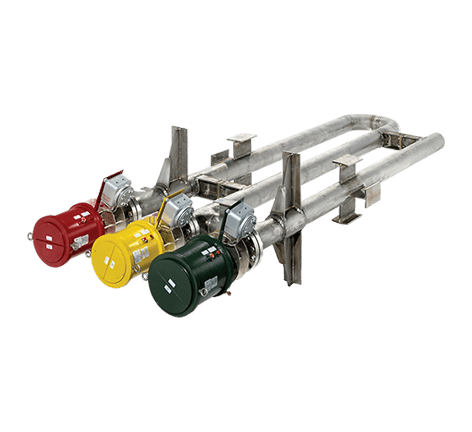
Caloritech (EX) circulation heaters are used in this high-temperature application to superheat the steam for the electrolysis unit to operate at optimal temperatures. Thermon’s steam superheating systems provide instantaneous heating of process steam to the solid oxide electrolyzer while only using the exact amount of power needed when paired with SCR controllers.
CLEANING AND PURIFICATION OF HYDROGEN
There are two primary methods to purify hydrogen gas, Pressure Swing Adsorption (PSA) and Temperature Swing Adsorption (TSA).
Pressure Swing Adsorption (PSA)
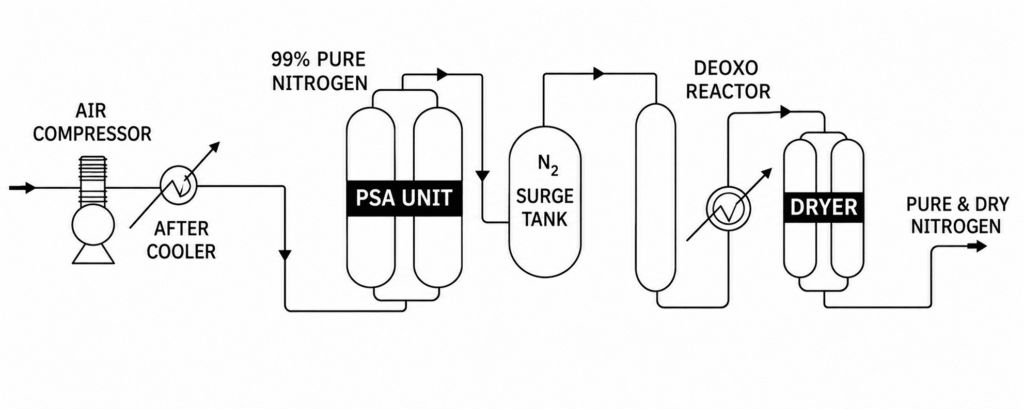
During the PSA process, the various gases separate under pressure and depend on the individual molecular characteristics of the gas, temperature, and affinity for the adsorbent material.
Adsorption occurs under high pressure. Gases will be attracted to and trapped on solid surfaces. The higher the pressure, the more gas is adsorbed.
Temperature Swing Adsorption (TSA)
TSA is a process that uses adsorbates to separate different gases. A gas stream containing multiple gases, including hydrogen, flows through a bed of particles at a low temperature, adsorbing the other gases or particulates to produce almost pure hydrogen. The gas flow switches to a clean bed when the adsorbate bed becomes saturated.
After the hydrogen leaves the DeOxo reactor, it still contains water. Pushing it through a column containing a membrane removes the water. Once the membrane is saturated, it is regenerated using an electrical heater to push through with hot air or nitrogen.
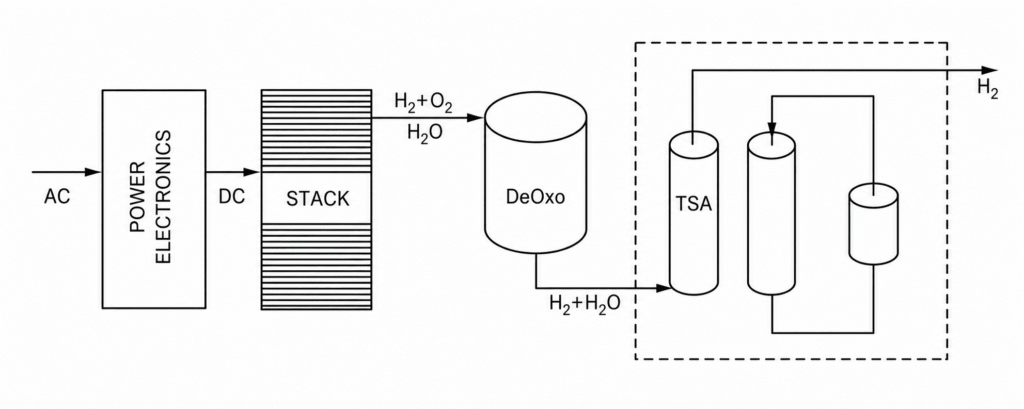
For both of these methods, Thermon’s EX-circulation heaters can serve as Electrical DI water heaters or electrical regeneration heaters.
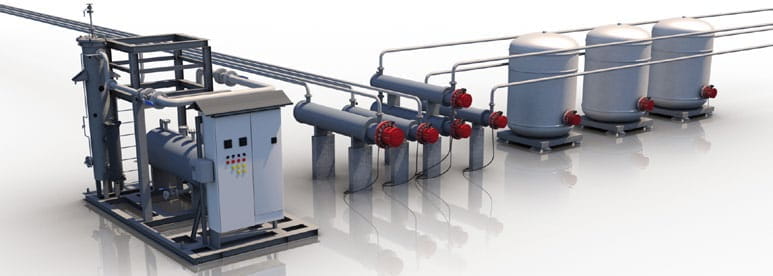
Thermon EX-circulation heaters are an excellent solution for preheating water before electrolysis. PSA systems require large draws of hot DI (Deionized) water with a fixed period between cycles, making electrical DI water heaters the best choice for electrolysis.
The system pictured above requires two EX-Circulation Heaters, an Electrical Regeneration Heater for the DeOxo reactor, and an Electrical Dyer heater for the TSA columns. The heaters regenerate the DeOxo reactor and TSA columns.
There are multiple benefits of using electric circulation heaters:
- They work at 100% efficiency
- Get hot within 1 to 2 minutes
- Have no moving parts
- Baffles optimize the heat transfer and reduce interior space to minimize the plot or footprint in the process
- If the electricity comes from a sustainable source, the heat is 100% fossil free with no CO2 emissions.
Smaller projects or pilot programs can replace DeOxo heaters with heat tracing around piping and vessels.
LOW CARBON HYDROGEN OR “BLUE” HYDROGEN
95% of the hydrogen produced in the U.S., and 76% globally, uses a process called steam methane reforming (SMR). High-temperature steam (700°C–1,100°C) reacts with a methane source, breaking it down into hydrogen and carbon.
Only seven blue hydrogen facilities are operating, four in the US and three in Canada, with over 20 plants developing in the next decade.
Hydrogen is a highly efficient energy source and used in a wide range of commercial applications such as:
- Heating and cooling buildings safely and cost-effectively
- Hydrogen-powered cars generate water, making them ideal for cities that face water scarcity
- Used to produce fertilizers and chemicals for the agricultural and industrial sectors
- Oil, gas, power generation, and mining
Applications of Hydrogen in Emerging Technologies
Hydrogen has established itself as a significant source of industrial energy.
New technologies that benefit from hydrogen power include:
- Hydrogen fuel cells that can power small drones, large trucks, or ocean-going vessels
- Hydrogen-powered airplanes and rockets
- Railroads and buses
To make the most of hydrogen’s benefits, work with a team experienced in setting up hydrogen production facilities worldwide.
THERMON SUPPORTS HYDROGEN GAS PRODUCTION AND POWER GENERATION
Globally, well over 100 hydrogen-powered turbine electric generators are producing electricity for the grid. Depending on availability, gas turbine plants can convert to burn higher concentrations of hydrogen or hydrogen-only.
Thermon is the leader in process heating and ISO 9001 Certified in eleven international manufacturing locations. We offer solutions for plants whose primary purpose is to bring power to the grid. As the world’s population grows, emerging markets gain access to power. Thermon provides companies with innovative solutions that reduce CO2 emissions and extend the life of power generation plants worldwide.
Advance Your Hydrogen Production Project
Thermon provides electric boilers, circulation heaters, steam superheating systems, heat tracing, and engineered thermal solutions for hydrogen production, purification, and power generation. Connect with our team to discuss the process heating requirements for your facility.